Sliding Puzzle with Numbers 1-24 in 8-Dot Braille
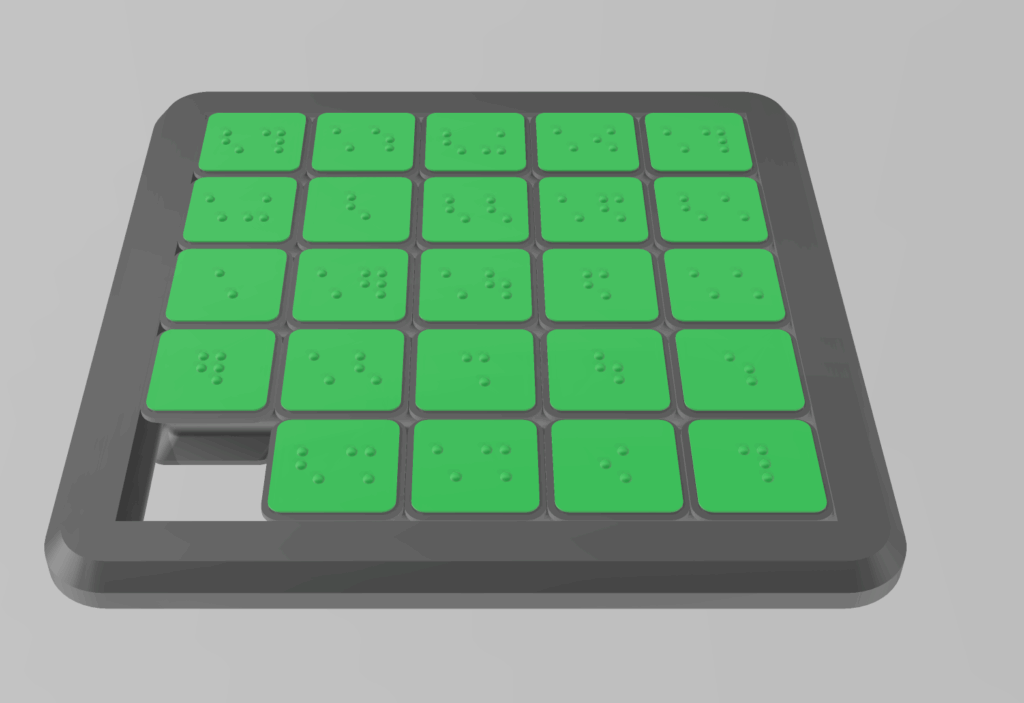
Description
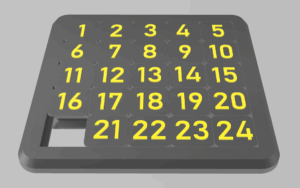
The puzzle works by sliding one of the 24 pieces around at a time. The pieces of the puzzle are numbered 1 to 24 in 8-Dot Braille. The aim of the puzzle is to push the number tiles back into the correct order. The sliding puzzle is a fun and challenging logic exercise and also strengthens concentration, problem-solving skills and number sense. The model is based on the one from zcassell and has been adapted and optimised accordingly for our user group. Das Puzzle funktioniert so, indem man jeweils eines der 24 Teile herumschiebt. Die Teile des Puzzles sind mit 1 bis 24 in 8-Punkt Braille nummeriert. Ziel des Puzzles ist es die Zahlenplättchen in die richtigen Reihenfolge zurückzuschieben. Das Schiebepuzzle ist eine lustige und herausfordernde Logikübung und stärkt dabei auch noch Konzentrationsfähigkeit, Problemlösekompetenzen und Zahlenverständnis. Das Modell basiert auf dem Modell von zcassell und wurde ensprechend für unseren Nutzerkreis angepasst und optimiert.
Printing instructions and tips
The puzzle consists of two parts: The puzzle itself (recess) and the Braille tiles. The tiles must be printed upright (possibly with a brim) and then glued into the sliding puzzle with superglue. The printer should be able to handle tolerances of around 0.2-0.3mm so that the puzzle is easy to use. If you print the puzzle from a silk filament, the pieces will slide even better (perhaps even too well). A layer height of about 0.15mm and infill of 10-15% is recommended. The base is optional, but recommended. Simply glue it to the frame from below with a few drops of superglue. Das Puzzle besteht aus zwei Teilen: Das Puzzle an sich (recess) und den Braille-Plättchen. Die Plättchens müssen aufrecht gedruckt werden (evtl. mit Brim) und mit Sekundenkleber im Anschluss in das Schiebepuzzle eingeklebt werden. Der Drucker sollte Toleranzen von etwa 0.2-0.3mm handeln können, damit das Puzzle gut bedienbar ist. Druckt man das Puzzle aus einem Silk Filament, dann rutschen die Teile noch besser (vielleicht sogar zu gut). Eine Schichthöhe von etwa 0.15mm sowie Infill von 10-15% ist empfohlen. Der Boden ist optional, aber empfehlenswert. Diesen einfach mit einem paar Tropfen Sekundenkleber von unten an den Rahmen kleben.
Downloads
- 1-24 Silding Puzzle 8 dot braile preview (not for printing) (3MF)
- 1-24 Silding Puzzle_bottom (STL)
- 1-24 Silding Puzzle_braille plates (SKP)
- 1-24 Silding Puzzle_braille plates (STL)
- 1-24 Silding Puzzle_recess (STL)
- 1-24 Silding Puzzle_recess (SKP)
Bundle of all files listed above.